Hunting and Wildlife Magazine - Issue 233 - Summer 2026
Words by: Tim Taylor
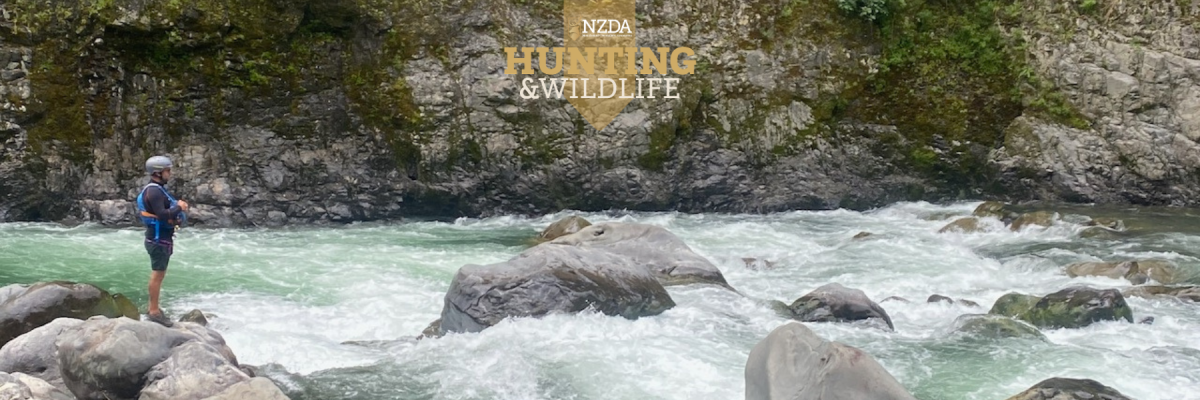
The word Motu translates to ‘isolated’, and I couldn’t think of a more apt word to describe how this river feels. Days away from any sort of civilisation, when you’re on the Motu, you’re alone. With steep canyons, bush to the water’s edge, and deafening silence, it reminded me of Fiordland. It’s a place where we humans feel very insignificant.
The Motu River has been on my to-do list for many years. Enjoying a Christmas beer with my whitewater buddy Matt, I said, “Let’s lock it in before we go back to work.” Phones came out, calendars were consulted, ‘leave’ was approved, and we were committed for a week in early January.

What did we know about rafting the Motu? The truth is, very little. We knew it would take 3-4 days and that it contained whitewater up to Grade 4. We found a trip description on the packrafting website that gave us great insight into how the trip should be broken down and what to expect each day. With rapid names such as ’the slot’, ’helicopter’, and ‘nasty rapid’, it sounded like it could be a rowdy trip. We also learned that the fourth day is basically 20 km of flat water, often with a strong headwind, so it’s preferable to arrange a jet boat pickup. At this point, I’d also like to mention that it’s not a trip that’s recommended for everyone. Grade 4 whitewater isn’t something you paddle on a whim, as it has some serious consequences if you cock it up. Both Matt and I have been paddling whitewater since we were teenagers, and Matt’s even a qualified rafting guide, so while we approached it in a very relaxed fashion, we knew our stuff.
During the preparation stage, I spoke with Mark from Motu River Jet. He regularly assists with these sorts of trips, so I asked if he knew anyone available to be a shuttle driver. As it turns out, he knew just the guy and was able to connect us with Kevin. The jet boat pickup cost us $600, and the shuttle from Opotiki was $150. While you might consider this a little on the high side, I consider it money well spent and highly recommend their services. The drive from Opotiki to the start of the Motu River takes roughly two hours, and from the end back to Opotiki is another hour, so paying for Kevin and Mark’s help made things extremely easy. It also made life stress-free, as this is not the sort of place you want to leave your vehicle on the side of the road!

Our first day on the river was nothing short of idyllic. Kevin waved us goodbye with a look that said, “I wish I were coming with you,” as we drifted lazily away.. Then we got to work. The day was about 18 km, which involved paddling through the flat sections, dragging through the shallow sections, and pushing off rocks in the whitewater sections. The river was flowing at only 5 m3 in these upper levels, which is considered extremely low, so it required us to invest a fair amount of sweat equity. However, the rapids were extremely tame at this level, and we concentrated on searching for deer. While we did see a couple, it turns out that shooting from a bouncing raft isn’t as easy as I’d imagined. The recommended camp for the first night is opposite ‘Blue Slip’, and there were explicit instructions on the packrafting website not to miss this spot, as shortly thereafter, you enter the first of the gorges, where there are no suitable campsites for many hours. While we were taking this guide with a grain of salt, we decided to play it safe, so we were finished day one around 2:00pm, which left us with enough time to go for an unsuccessful evening stalk and a swim.
Like most things in life, how you perceive whitewater is largely dependent on your experience level, and I would describe day two as being a tad exaggerated. The use of the word ‘gorge’ was a bit of a misnomer, and our joke of the day became: “Oh, there are no campsites here”. The fact was that there were numerous good spots, and we were a bit brassed off at having not carried on for a few more kilometres the night before. On the bright side, as we passed more side creeks, the river level was coming up, and we no longer had to drag the raft through the rapids. The grade of the rapids also jumped up, becoming slightly more technical and requiring us to don our helmets. Now jumping out and scouting each rapid is generally recommended at this level, as you need to decide on your line and check for hazards such as trees. However, Matt and I have become a bit lazy over the years, so we developed a system that we coined the ‘float scout’, which was basically drifting up to the edge and standing up on the raft to see where to go. This allowed us to save a huge amount of time and worked out well.
‘The slot’ was the most notable rapid of the day, not because it was particularly dangerous, just that it turned out to be narrower than our raft. Something we only discovered when we were jammed in it. Utilising years of technique (absolutely winging it) and force (our fat asses), we were able to tip the raft on its side and bounce through it without needing to unload.

While it didn’t involve a rapid, another notable obstruction was a gigantic Tawa tree that had come down with a recent slip, completely blocking the river. It occurred in an area where the banks were quite steep, so the only solution was to completely unload our gear, carry it all to the other side, then drag the raft over the top. It’s safe to say that we were a bit buggered after that, so we swung a billy and enjoyed hot dogs for lunch to regain some energy.
Nearing the end of day two, we rounded a corner and spied a deer feeding head down on the left-hand bank. Having already missed a few deer, we’d decided that if presented with such an opportunity, we would head to the riverbank and jump out for a solid rest. The setup was perfect. The wind was blowing upstream, the deer facing downstream, and I was able to silently guide the raft to the bank and hand Matt the rifle. “It’s a stag”, he whispered. “Put the cross hairs on the front shoulder, and when you’re ready, let one fly, mate”, I replied. As the report of the 25.06 echoed down the valley, the stag fell with Matt securing his very first deer.

We floated the next rapid and pulled up metres from the deer, noting an eel had already smelt the action. It was a beauty of an 8-point stag, with a nice covering of fat over its back, and our only disappointment was that the top tines were still in soft velvet. We enjoyed feeding the eels as we completed the butchery and left the head on a prominent rock to greet the next crew. Around the very next corner was our camp for the night, affectionately known as camp 2A on the maps. It had been eight hours of continuous paddling, and we were asleep before the sun set!
Our final day on the river would be best described as a day for ’the paddlers’. The grade of whitewater jumped up another notch, touching Grade 4, with the character of the rapids changing to big boulders with pool drops, as well as a few longer, more technical rapids that required multiple moves. You couldn’t see the bottom of many of the rapids, and we were forced to get out and scout where necessary. If you weren’t familiar with whitewater these would probably have been the moments when your bum got a little tighter, however our grins couldn’t have been wider. The biggest rapid of the day is known as ‘Helicopter Rapid’ because, apparently, there was once the wreckage of a chopper here. We spent a good 15 minutes scouting it, and while there was a line, it was tight, and the crux move required us to throw the raft over to starboard to prevent us from being wrapped around a big pin rock in the middle. Now, many people would probably have walked this one, but the boulders were the size of houses, and given it was a good 200 m long, we had zero appetite for carrying our gear all the way to the bottom. It wasn’t going to be easy, but ultimately Matt just said, “F**k it, we’ll bounce through like we always do”, and that was good enough for me. Well, we bounced all right, and flushing out the bottom, we burst out laughing. Looking back up at it, Matt proclaimed, “Yeah, that’s not a rapid I’d normally raft.”
We had been making good time, and over a lunch of bacon butties, we realised we were going to be finished several hours earlier than planned. Matt reckoned we should contact the jet boat driver to see if he was around and, if so, get picked up later that afternoon rather than in the morning. With the wonders of Elon’s satellites, a text went out, and we were just arriving at the pickup point when we received a response, “Deflate the raft, boys, I’ll be there in 20.” The remaining 20 km flew by at 80 km/h, and as we raced towards civilisation, we sure were happy not to be paddling. Approaching the coast, the river doubled in width, and the headwind looked fierce. “You’d still be paddling this time tomorrow if I weren’t available”, Mark proclaimed. Incidentally, the following day, the area was hit by the storm, which closed the Waioeka Gorge and stranded motorists between slips. Sipping a hot cuppa and going through my photos, I checked the river gauge and was astonished to find it reading 250 m3…I think we’d have been travelling faster than the jet boat at that flow!
Read Hunting & Wildlife Magazine
NZDA members receive an electronic version by email, and can access it on the NZDA app. Subscriptions and physical copies can be purchased online. Visit the NZDA Shop at www.nzda.shop
Missed an issue?
We make our older editions free to read online. Browse the back catalogue here.
Write for Hunting and Wildlife